Excess upper eyelid skin
Skin that covers the eyelid crease or, in some cases, restricts the field of vision.

Eyelid surgery addresses changes such as excess skin and under-eye bags through individualized assessment and, where appropriate, surgical treatment.
Excess skin on the upper eyelids may also affect the visual field in some people. Surgical planning considers eyelid closure and ocular surface health as well as a natural appearance.
Op. Dr. Bilal Kavşut evaluates eyelid anatomy and individual expectations at his clinic in Güneşli, Bağcılar, Istanbul.
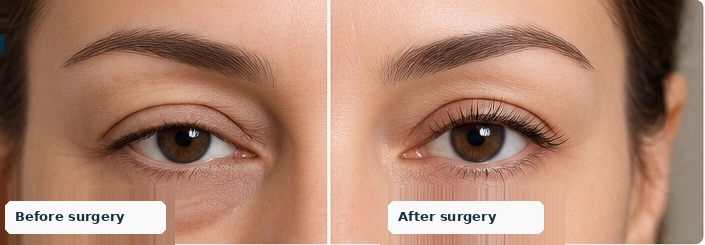
Blepharoplasty is a surgical procedure intended to address excess skin and, where appropriate, fatty tissue in the upper or lower eyelids.
Some people primarily have excess upper eyelid skin, while others are more concerned about lower eyelid bags. Drooping eyebrows or true eyelid drooping (ptosis) may require a different assessment.
Treatment planning therefore considers eyelid function, ocular surface health and examination findings, rather than appearance alone.
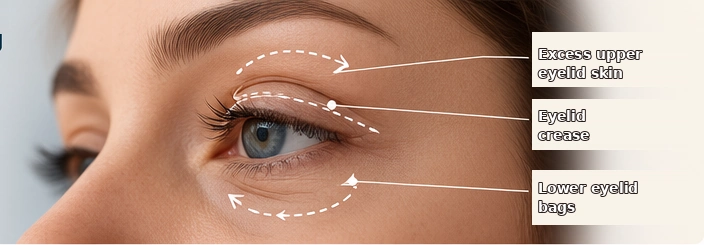
Skin that covers the eyelid crease or, in some cases, restricts the field of vision.
Prominence of the fat around the eyes and changes in the lower eyelid contour.
Cosmetic concerns associated with age-related changes around the eyes.
Differences in eyelid appearance that require a detailed examination to determine the cause.
Dark circles, fine wrinkles and drooping eyebrows are not always corrected by blepharoplasty. Other treatment options may be considered during the consultation.
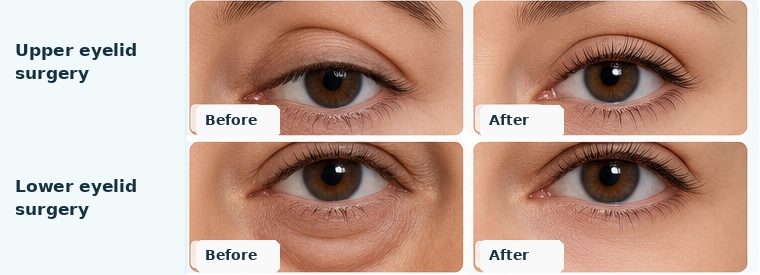
Excess skin and, when needed, appropriate fatty tissue are adjusted. The incision is usually placed in the natural upper eyelid crease. Removing skin that restricts the visual field may provide a functional benefit.
Fat contributing to under-eye bags may be adjusted or repositioned using an appropriate technique. Depending on eyelid anatomy, the incision may be made below the lashes or on the inner surface of the eyelid.
Upper and lower eyelid procedures can be performed during the same operation in suitable patients, but not everyone needs both areas treated.
Eyelid skin, fatty tissue, eyelid position, closure function and the ocular surface are assessed.
Local anesthesia, sedation or general anesthesia may be considered depending on the extent of the procedure. The planned adjustments to skin and fatty tissue are carried out.
Swelling, bruising and temporary tenderness may occur. Recommended care and medications should be followed.
Healing is assessed at follow-up visits; removal of stitches is arranged if needed.
The duration of surgery and suitability for same-day discharge depend on the procedure and the patient's condition.
Swelling, bruising, tightness and tenderness may occur around the eyes during the first few days. Swelling and bruising often improve substantially within one to two weeks, although complete tissue healing may take longer.
Follow your doctor's instructions regarding cold compresses, medications and follow-up visits. The timing of your return to eye makeup, contact lenses and strenuous activity is determined individually.
Symptoms requiring urgent assessment: Seek medical attention promptly if you develop severe or worsening pain, sudden vision loss, significant bleeding or unexpected swelling.
The upper eyelid incision is usually placed in the natural crease. Depending on the technique, a lower eyelid incision may be made just below the lashes or inside the eyelid. Scars may become less noticeable over time, but completely scar-free healing cannot be guaranteed.
Potential risks include bleeding, infection, delayed wound healing, asymmetry, dry eyes, incomplete eyelid closure and unwanted changes in eyelid position. Rarely, serious vision-threatening complications may occur.
The expected benefits, limitations and potential risks should be discussed thoroughly before surgery.
No. Blepharoplasty primarily addresses excess skin and, when appropriate, fatty tissue. Ptosis surgery aims to correct the mechanism that lifts the upper eyelid.
Some patients have both excess skin and ptosis. In such cases, each condition is assessed separately and an appropriate surgical plan is developed.
The aim of eyelid surgery is not simply to remove as much skin as possible, but to achieve an individualized result while preserving the natural eyelid contour and the closure function that helps protect the eye.
Ocular surface health, tear film, eyebrow position and eyelid anatomy are important aspects of surgical planning.
Good eyelid surgery planning takes into account the eyelid's natural appearance, closure function and ocular surface health together.
Op. Dr. Bilal Kavşut uses his professional experience in ophthalmology to assess eyelid anatomy, visual function and patient expectations when considering appropriate options.
You can book an examination in Güneşli, Bağcılar, Istanbul, to discuss upper eyelid drooping, under-eye bags or eyelid surgery.
There is no single age limit that applies to everyone. The need for surgery is assessed based on eyelid anatomy, symptoms and general health.
The changes made by surgery may be long-lasting, but natural aging continues and appearance cannot be guaranteed to remain unchanged for life.
Swelling and bruising often improve considerably within one to two weeks. Complete healing and the final appearance may take longer.
The procedure is performed with appropriate anesthesia. Mild pain, tightness or tenderness may occur afterward. Severe pain or changes in vision require urgent assessment.
Incisions are planned in natural eyelid creases or other appropriate anatomical locations when possible. Scars may become less noticeable over time, but scar-free healing cannot be guaranteed.
Both areas can be treated in one operation for suitable patients. The decision depends on eyelid anatomy, eye health and the extent of surgery.
If excess upper eyelid skin restricts the visual field, suitable surgery may reduce that obstruction. Blepharoplasty is not intended to correct refractive errors.
Contact us to learn more about upper eyelid drooping, under-eye bags and other eye health concerns, or to book a consultation with Op. Dr. Bilal Kavşut.